Asphalt shingles
Granules, tabs, seal strips, age, prior repairs, and wear make forceful washing inappropriate. Worn, curled, brittle, or damaged shingles may not be candidates for cleaning.
Low-pressure roof care
Roof washing treats exterior organic streaking without using the aggressive impact appropriate for some ground-level hardscapes. The roof's material, condition, drainage, access, and existing wear must guide the service.
Why roofs develop dark streaks
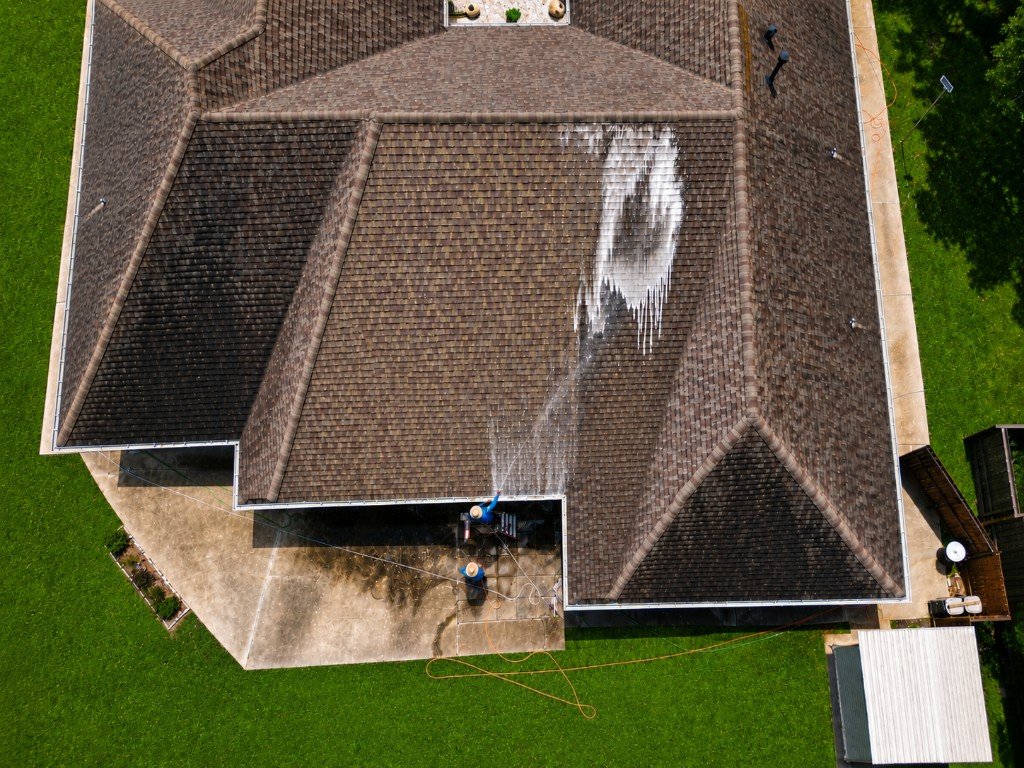
Dark roof streaks are commonly associated with algae-like organic growth, but visual inspection alone does not confirm a specific organism. Roofs may also hold lichen, moss, leaf residue, pollen, soot, atmospheric soil, and debris concentrated below trees, roof features, or upper slopes. Metal roofs can show organic film alongside oxidation, runoff marks, or coating changes that require a different interpretation.
Houston's warm, humid climate and frequent rainfall can keep shaded roof planes damp. Tree cover slows drying and adds organic debris. North-facing slopes or areas below overhanging branches may show streaking first, while open sunny planes may exhibit more coating wear or heat-related aging.
Homeowners usually request roof washing because black streaks have become visible from the street, an inspection has noted organic buildup, or the roofline looks inconsistent with the rest of the exterior. The goal is to treat serviceable surface contamination while preserving a weathering system that is more vulnerable than a driveway.
Roof system characteristics
Serviceability must be established before any cleaning treatment is applied.
Granules, tabs, seal strips, age, prior repairs, and wear make forceful washing inappropriate. Worn, curled, brittle, or damaged shingles may not be candidates for cleaning.
Panel coatings, seams, fasteners, penetrations, oxidation, chalking, runoff, and roof pitch affect the plan. Cleaning does not restore a failed coating or remove every corrosion mark.
Material strength, breakage risk, installation, walking restrictions, and manufacturer guidance require case-by-case review. Not every roof type or access condition can be serviced safely.
Recommended approach
A roof-safe approach uses controlled application at low pressure so the treatment can act on organic contamination. Rinsing strategy depends on roof material, condition, runoff, weather, and the service plan. Some treated residue or lichen attachment can release gradually with normal weather rather than being mechanically forced from a delicate surface.
The method should account for gutters, downspouts, valleys, landscaping, siding below, painted metals, solar equipment, skylights, vents, and roof penetrations. Application does not begin until the operator understands where runoff will go and which adjacent materials need protection or additional rinsing.
High-pressure “instant results” can be a poor trade when they require impact that the roof was not designed to receive. Similarly, scraping, harsh agitation, walking fragile areas, or applying one treatment strength to every roof can create unnecessary risk. Soft washing describes the pressure category; professional judgment still determines whether the entire procedure is appropriate.
Soft Wash Houston process
Steepness, roof geometry, landscaping, drainage, and nearby surfaces make each roof scope different.
Property photos and access notes establish roof size, visible streaking, material, solar equipment, height, and obvious constraints.
The roof, access approach, wear, penetrations, gutters, adjacent metals, landscaping, and runoff paths are reviewed before work.
Downstream surfaces and plants are accounted for with controlled application, wetting, diversion, observation, and rinsing as needed.
The serviceable roof areas receive a material-appropriate treatment without relying on concentrated water impact to strip the surface.
Coverage, runoff areas, remaining material wear, and any growth expected to release gradually are documented or communicated.
Realistic expectations
Dark organic staining often shows substantial improvement after treatment. The timing is not identical on every roof. Some residue may change immediately, while thicker organic attachment can continue to weather away after the initial service. The final appearance depends on material, severity, age, slope, shade, and previous damage.
Permanent color variation, granule loss, exposed substrate, old repairs, rust, oxidation, coating failure, sealant marks, and damage can remain visible. Areas beneath solar panels or equipment may be inaccessible. Heavy lichen or moss may leave a visible footprint even after the biological material is no longer active.
Weather affects timing and runoff management. Wind or rain may require rescheduling; later rainfall may help loosen treated residue, but it is not a substitute for the controlled service and protection plan.
Before and after service
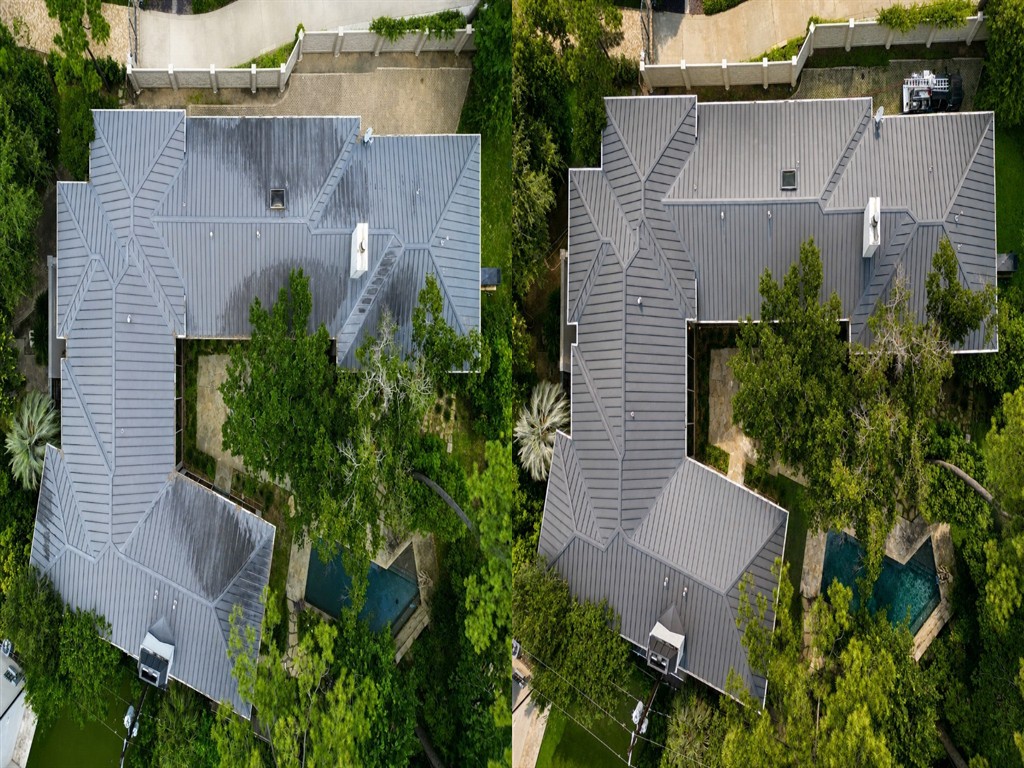
Clean based on condition rather than a rigid calendar. Periodically view the roof from the ground and watch shaded planes, areas under trees, and slopes below upper-roof drainage. Recurrence can be faster with dense tree cover, persistent shade, poor airflow, organic debris, and Houston humidity. Trimming appropriate overgrowth and keeping drainage functional may reduce moisture retention, but roof work and tree work should be handled by qualified professionals.
Connected exterior systems
Looking specifically at black streaks? Visit roof algae removal in Houston. You can also read the standing-seam metal roof case study or see the roof washing gallery.
Questions homeowners ask
No. Material, age, wear, leaks, access, pitch, repairs, and manufacturer or installer guidance can make a roof unsuitable for service. A condition and access review comes before method selection.
Treatable organic streaking should improve, but rust, asphalt bleed, mechanical damage, granule loss, oxidation, coating failure, and permanent discoloration may remain. Some treated organic material can also lighten gradually after service.
The roof and solar array need to be evaluated together. Panels, wiring boundaries, mounts, runoff paths, and inaccessible roofing beneath the array can change the scope. Solar modules should not simply be treated as part of the roof surface.
Not automatically. Treating the roof surface is different from removing debris inside gutters or correcting drainage problems. If gutters are full or overflowing, identify that when requesting the quote.
Known or suspected leaks should be disclosed before service. Cleaning does not repair flashing, underlayment, penetrations, seals, or roof damage, and a compromised area may need repair before washing.
Condition before cleaning
Send full-slope views, close photos of the streaking if safely available, and notes about roof material, age, solar panels, leaks, tree cover, gutters, and access. Do not climb the roof to take quote photos.